We Analyzed 3,572 Top-Ranking Jewelry Listings on Alibaba.com (Here's What Sells)
Every jewelry buyer and brand owner we talk to asks the same question: what actually sells? Suppliers answer with opinions. We wanted numbers.
So we pulled every product on Alibaba.com's official TOP Ranking channel across the fashion jewelry categories its ranking system associates with stainless steel jewelry — three board types (Hot selling, Most popular, Top rated) across three regional rankings (Global, US, Europe), every leaf category, down 20 positions. That's 3,572 ranking slots covering 1,925 unique products, each with its listed price, minimum order quantity, order count, and material claims as displayed on 5 September 2026.
Here is what the data actually shows — including a few things that surprised us.
Key Takeaways
- Necklaces (840 slots) and earrings (837) together hold 47% of all top-ranking slots. Rings hold just 8%.
- The ranked market lives between $1 and $5: median listed price is $2.30, and half of all products sit between $1.19 and $3.67.
- The MOQ barrier has collapsed: the median minimum order is just 6 pieces, and 82% of ranked listings ask for 12 pieces or fewer.
- Orders are thin per listing and concentrated at the top: the median hot-selling listing shows 20 orders, and the top 10% of listings take 33% of all orders.
- 86% of listings say "stainless" — but only 6% name the actual grade (e.g. 316L). Material transparency is the exception, not the rule.
- Ratings are saturated: the median ranking listing shows a 5.0-star score. Stars no longer tell top sellers apart.
How We Got This Data
Alibaba.com publishes an official TOP Ranking channel that ranks leaf categories by three metrics: total orders (Hot selling), views plus interested buyers (Most popular), and average rating (Top rated). Each metric is ranked for the Global, US, and European markets separately, 20 products deep.
We collected every ranking in the fashion jewelry branch of this channel for the stainless steel jewelry category path on 5 September 2026 — 21 leaf categories, from stud earrings and chain necklaces to anklets and brooches (smart bracelets were excluded). After removing duplicates, the dataset covers 3,572 board slots and 1,925 unique products.
Two notes on method: prices are the listed unit prices displayed on each ranking entry, and MOQs are the per-SKU minimums as displayed. Where Alibaba shows "+" figures (e.g. "40+ orders"), we used the stated number as a floor.
Finding 1: Necklaces and Earrings Split the Rankings — Rings Barely Show Up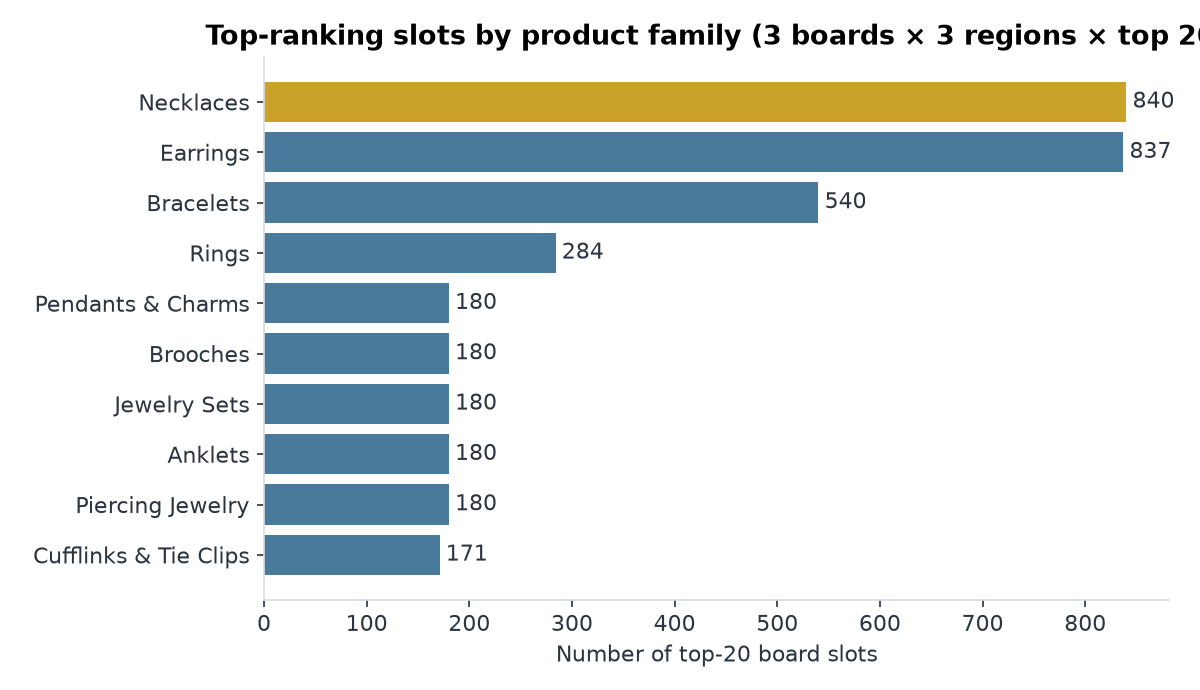
Necklace categories hold 840 of the 3,572 top-ranking slots and earrings hold 837 — together 46.9% of the entire ranked surface. Bracelets follow with 540 slots. Rings, despite being arguably the most emotionally loaded jewelry category, hold only 284 slots (8%).
Part of this is structure: Alibaba's tree simply has more necklace and earring leaf categories (five each in our set) than ring categories. But that is the point — the platform's buying demand organizes itself far more densely around necklaces and earrings, which is exactly where a new brand's catalog gets the most ranking surface to compete for.
If you're building a stainless steel jewelry line, necklaces and earrings are where the shelf space is.
Finding 2: The Ranked Market Lives Between $1 and $5
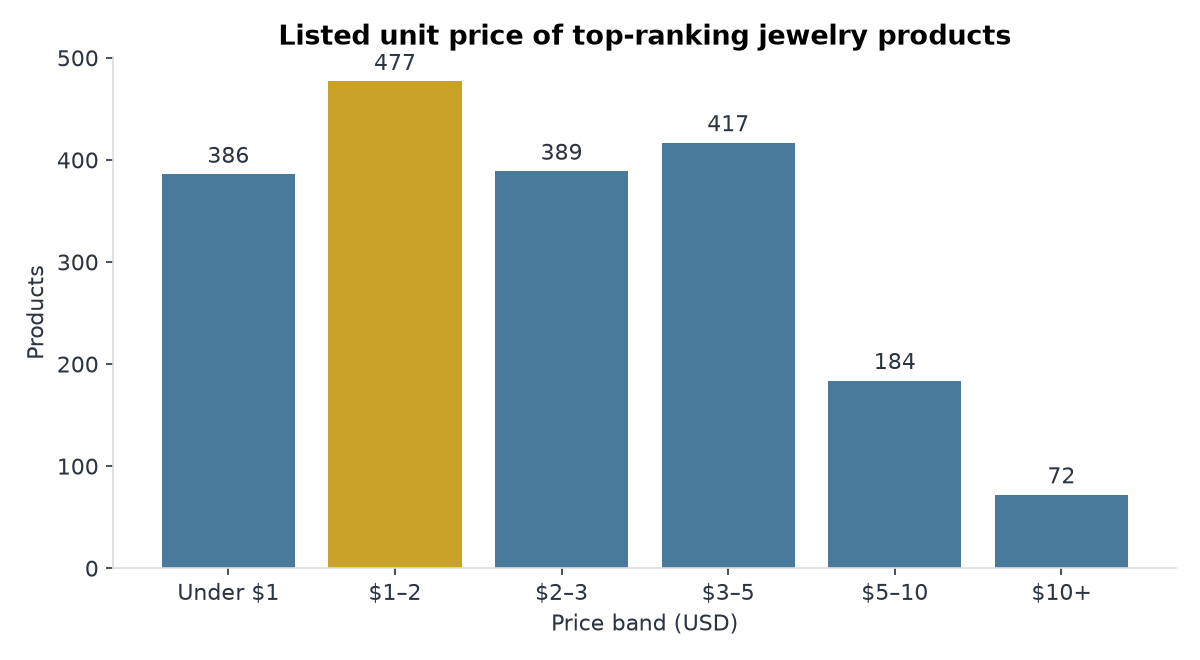
The median listed price across all 1,925 products is $2.30, and the middle half of the market sits between $1.19 and $3.67. Only 72 products — under 4% — list above $10.
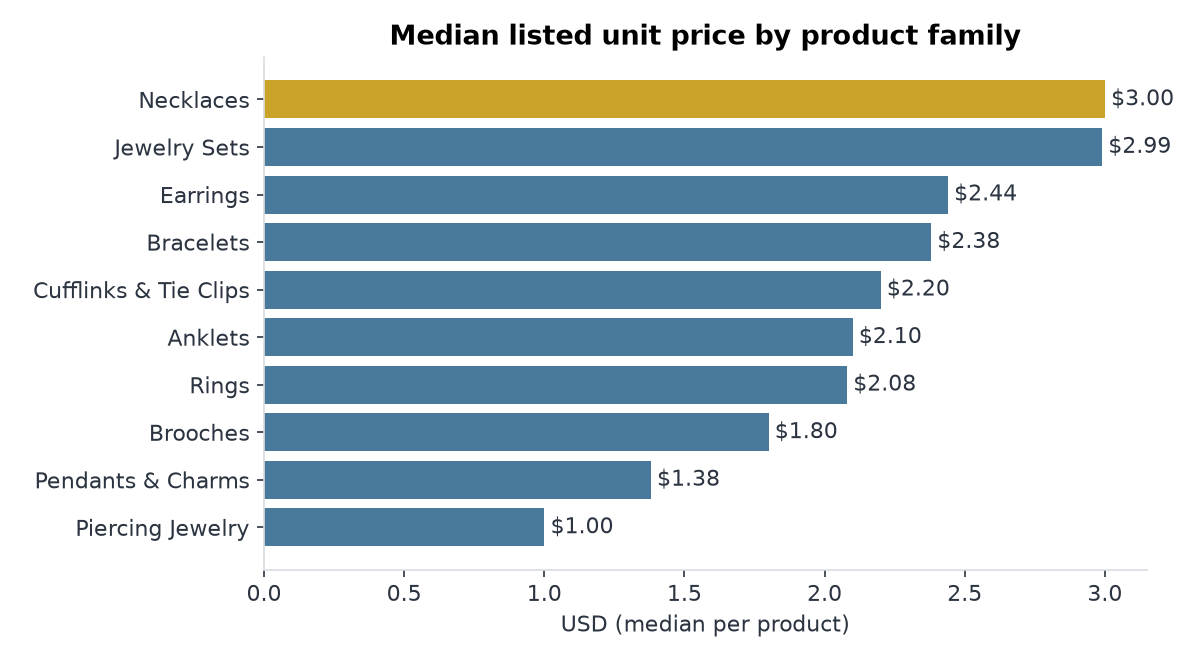
By family, necklaces command the highest median price ($3.00), followed by jewelry sets ($2.99) and earrings ($2.44). Piercing jewelry ($1.00) and pendant charms ($1.38) anchor the bottom.
There's also a regional angle: the US ranking board's median price is $2.40 versus $2.00 on the Global board — US-facing listings price about 20% higher.
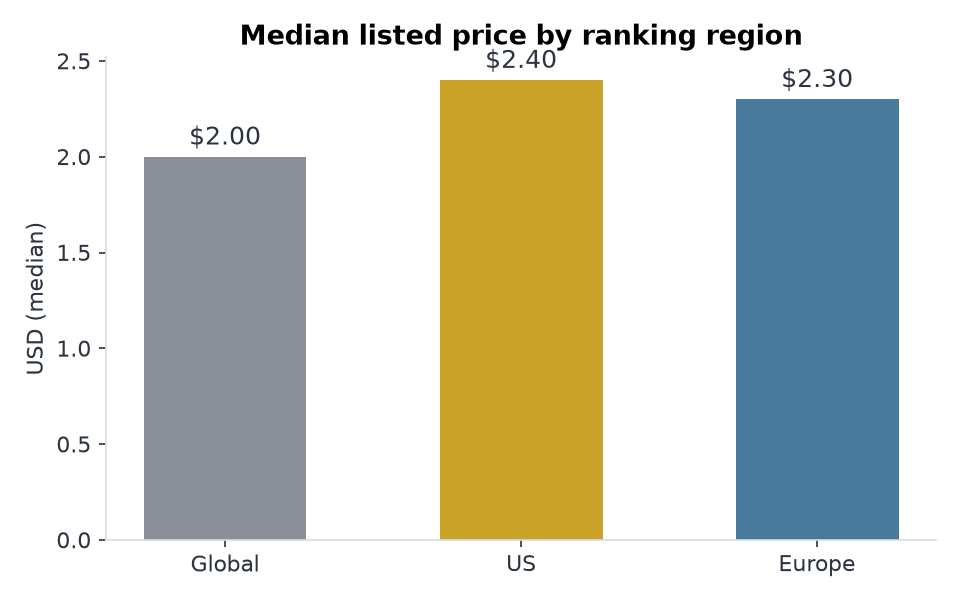
The lesson isn't "price low." It's that the winning range for ranked, ready-to-ship stainless steel jewelry is a $1–5 window — and necklaces, not earrings, are where you can charge the top of it.
Finding 3: The MOQ Barrier Has Collapsed
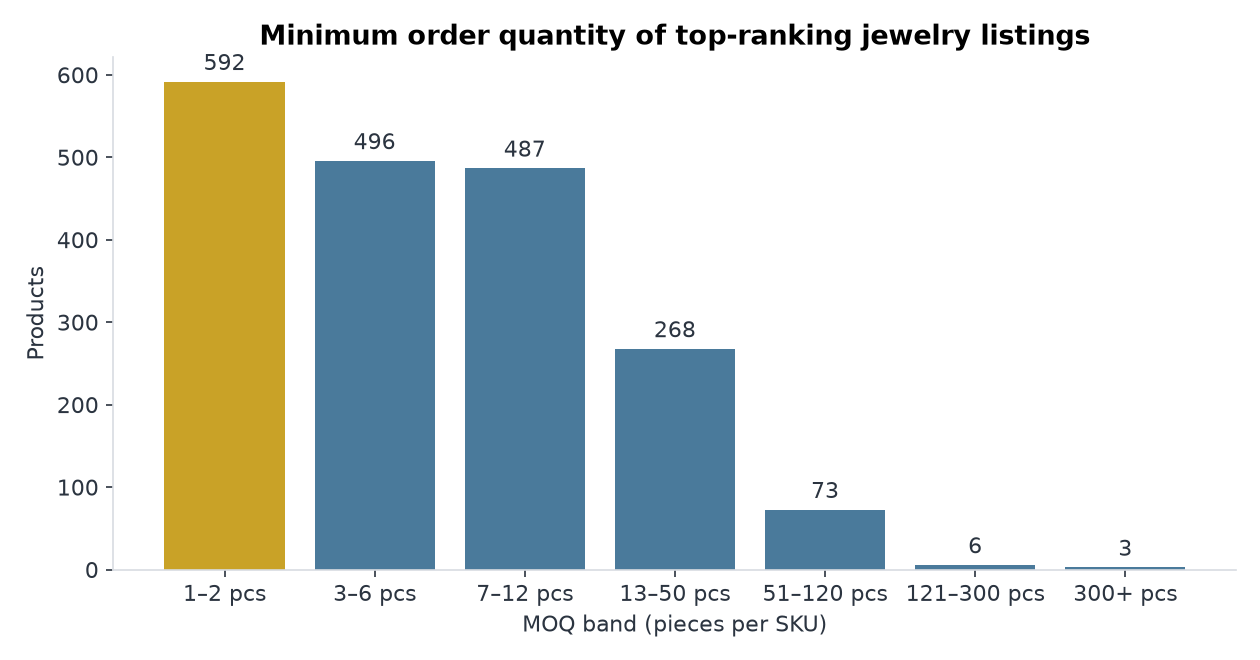
This was the finding we had to double-check. The median minimum order quantity among ranked listings is 6 pieces. Fully 81.8% of ranked listings ask for 12 pieces or fewer, and 99.5% ask for 120 or fewer — per SKU.
The rankings surface a ready-to-ship market, and that market has decided: minimums that once defined wholesale (500, 1,000 pieces) are gone from the top of the platform. Buyers test designs in dozens, not thousands.
An honest caveat: this is a selection effect. Alibaba's ranking system favors in-stock, ship-fast SKUs, and custom OEM/ODM programs — your own molds, your own packaging — still carry higher minimums because they carry real setup work. But the direction of travel is unmistakable: if your "wholesale" still starts at 500 pieces, the ranked market has moved past you. (This is precisely why we run our own custom program at an MOQ of 120 pieces per design.)
Finding 4: Orders Are Thin per Listing — and Concentrated at the Top
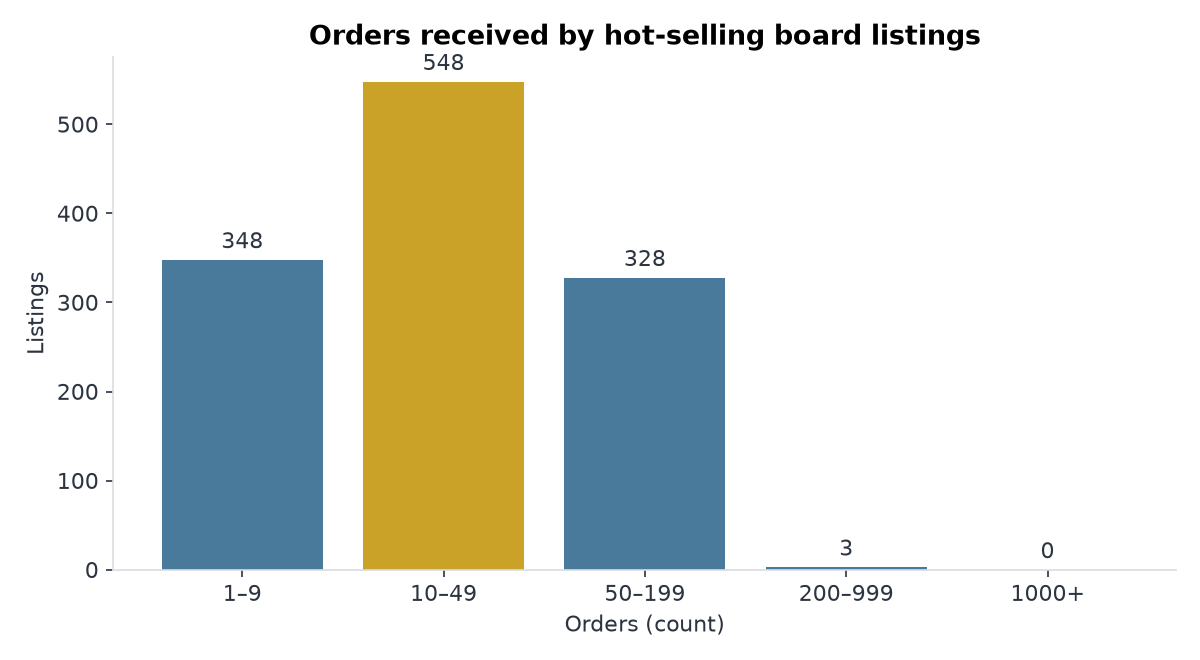
On the Hot selling board (1,227 listings), the median listing shows 20 orders. The top 10% of listings capture 32.9% of all orders. And here's the striking part: not a single ranked listing shows 200+ orders.
That's not weak demand — it's how wholesale works. An "order" is a transaction, and each transaction at wholesale can be hundreds of units (the "sold" counters on these same listings regularly read in the thousands). But the practical implication for suppliers is real: ranking visibility does not equal order volume, and the gap between the median listing (20 orders) and the top decile is where all the money is. Winning products win disproportionately.
Finding 5: 86% Say "Stainless" — But Only 6% Name the Grade
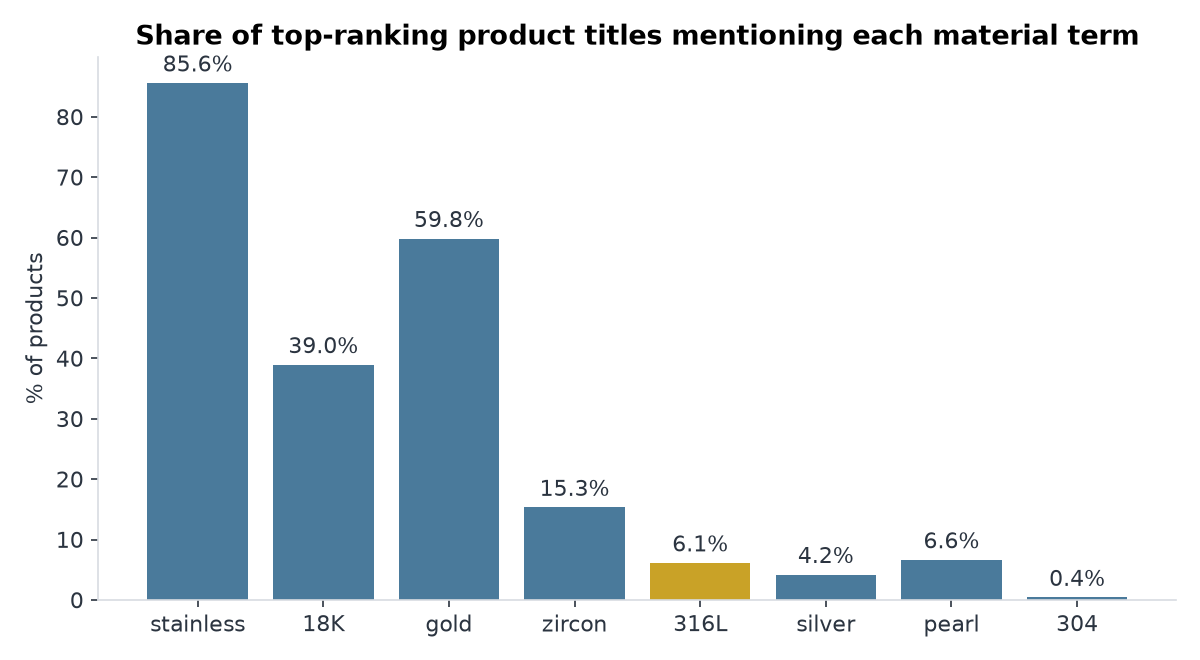
We scanned every product title for material claims:
- 85.6% mention "stainless" or "stainless steel"
- 59.8% mention gold (overwhelmingly as "gold plated" styling — 39.0% literally say "18K")
- 15.3% mention zircon stones
- 6.1% name an actual steel grade — almost always 316L
- 0.4% say 304
Read that again: nine in ten ranked listings sell "stainless steel," but four in five don't tell you which stainless steel. Grade is the single biggest determinant of whether that jewelry will survive sweat, shower and a year of wear — as we explain in our 304 vs. 316 steel comparison — yet the ranked market treats it as a secret.
For buyers, this is your diligence checklist compressed into one line: any supplier who won't state the grade per SKU in writing is asking you to accept their risk. For suppliers, it's the widest open gap on the platform: grade transparency is a 6% game, and 94% of the shelf is unclaimed.
Finding 6: Ratings and Seniority No Longer Differentiate
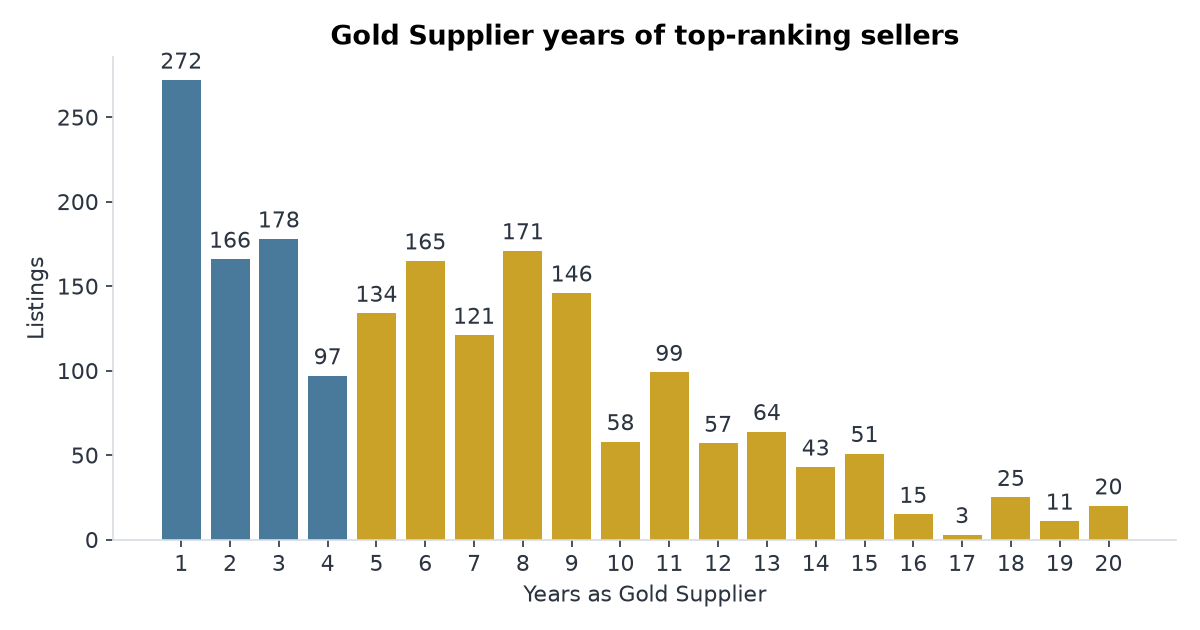
The median ranked listing carries a 5.0-star rating (82.7% are at 4.8 or above), and the median seller has 6 years as a Gold Supplier (62.4% have five or more). When everyone is a five-star, six-year veteran, neither number helps you choose.
On a saturated-trust platform, differentiation moves to things stars can't show: grade transparency, plating process, sample speed and how a supplier handles a defective batch. Stars got everyone in the door; they no longer decide who wins the order.
What This Means for Jewelry Brands and Importers
- Build your catalog around necklaces and earrings first. They hold 47% of the ranked surface and the highest price medians. Rings are a complement, not a flagship.
- Price into the $1–5 window for ranked, ready-to-ship SKUs — and look at necklaces when you want to reach for $3+.
- Test in dozens, not thousands. With the median MOQ at 6 pieces for stock SKUs, there is no excuse for six-figure inventory bets on unproven designs. Reserve higher MOQs for custom pieces where molds justify them.
- Make grade disclosure a supplier filter. "Stainless steel" without a grade is a styling claim, not a material spec. Ask per SKU, in writing.
- Judge suppliers by behavior, not badges. With ratings saturated, weight sample speed, defect handling and batch color consistency over star averages.
Limitations
This is a snapshot (5 September 2026) of one platform's ranking surface, and rankings carry selection bias toward ready-to-ship listings. "+"-suffixed counts are floors, not exact values; order counts are transactions, not units; and the same product can occupy slots on several boards, which is why slot-level and product-level analyses are reported separately. Regional boards overlap with the Global board, so regional medians indicate direction, not precise national pricing. None of these caveats change the direction of the findings — but anyone quoting exact figures from this study should quote them with the caveats.
FAQ
What is the best selling jewelry category on Alibaba? By ranked surface, necklaces and earrings — together they hold 47% of the top-20 slots across the official rankings in our dataset (840 and 837 slots of 3,572 respectively). Rings hold only 8%.
What is a typical MOQ for jewelry on Alibaba? Among top-ranking listings in our dataset, the median MOQ is 6 pieces per SKU, and 82% of listings ask for 12 or fewer. Custom OEM/ODM programs typically require higher minimums than ready-to-ship stock.
How much does stainless steel jewelry cost wholesale on Alibaba? The median listed price among top-ranking stainless steel jewelry products is $2.30 per unit, with the middle half of the market between $1.19 and $3.67. Necklaces carry the highest median ($3.00) among major categories.
How can I tell if jewelry is really 316L stainless steel? Ask the supplier to state the grade per SKU in writing — in our dataset only 6.1% of ranked listings do so voluntarily. For the material difference that makes 316L the standard for skin contact, see our 304 vs. 316 comparison.
 Private Label vs. White Label Jewelry: Which to Choose?
 What Is PVD Gold Plated Jewelry? (And Why It Lasts)
 What Does Wearing an Anklet Mean? Left or Right Ankle
 How to Clean Stainless Steel Jewelry the Right Way