
How to Stack Bracelets: The Wrist Styling Guide
Stack bracelets with one anchor piece and one to three echoes — mixing widths and textures while keeping one metal dominant — and the wrist reads styled instead of loaded. That's the entire formula. Bracelet stacking is the fastest jewelry trend to start (you already own the pieces) and the easiest to get wrong by one piece, so the formula earns its keep.
This is the wrist companion to our ring stacking guide and necklace layering system: same principles, new canvas — with a few wrist-specific rules the other guides don't need.
The Anchor-and-Echo Formula
Every good wrist stack has the same skeleton:
- The anchor: the piece with the most character — a chunky chain, a wide cuff, a beaded statement. One per wrist; this is what the eye lands on.
- The echoes: one to three quieter pieces — thin chains, a smooth bangle, a small beaded strand — that repeat the anchor's tone without competing.
- The spacing logic: contact is fine between echoes, but the anchor needs room to be read. Clasp-side crowding is the classic mistake.
One hero, a few supporting notes, and a wrist that looks curated from across the room — that's the test.
The Combinations That Always Work
| Stack | Pieces | Reads as |
|---|---|---|
| The classic duo | Chunky chain + thin plain chain | The entry-level stack; works with everything |
| The texture mix | Beaded strand + smooth bangle + thin chain | Bohemian-leaning, rich in contrast |
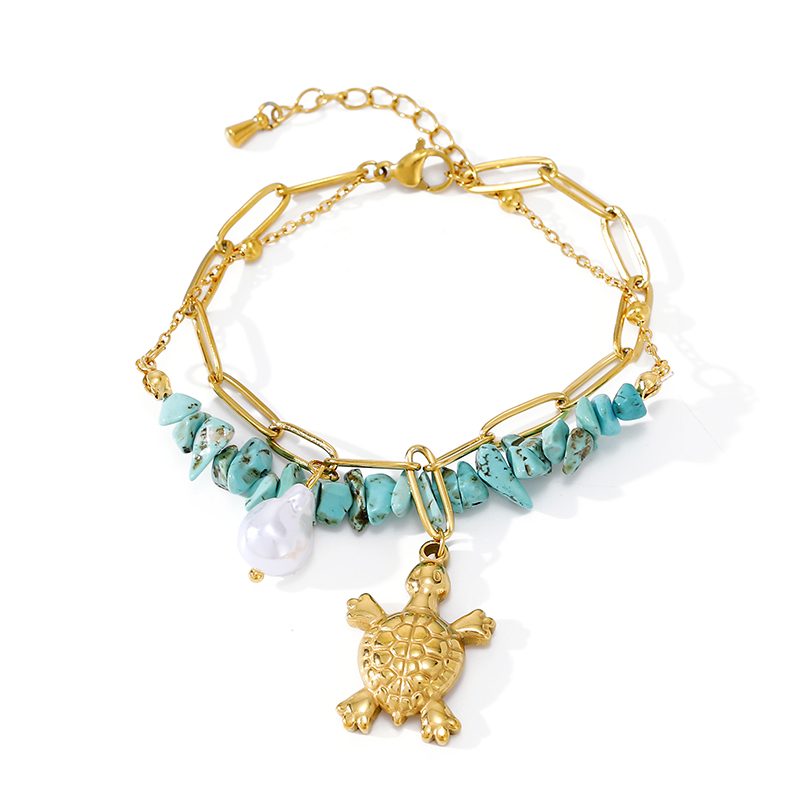
| The double-layer | One double-strand bracelet worn as the anchor | Pre-styled architecture; the layered turquoise look |
| The hard-soft pair | Rigid bangle + slouchy chain | The contrast play — structure against fluidity |
| The full wrist | Anchor + 3 echoes across the wrist | Confident maximum; keep metals unified |
| The watch pairing | Watch + 2 thin chains on the far side | The office classic; watch acts as the anchor |
The Wrist-Specific Rules
Bracelets live differently than rings — they swing, clink and catch. Four rules the other stacking guides don't need:
- Sound is part of the design. Metal-on-metal clinking is charming in a bar and less charming in an open-plan office. Bangle-heavy stacks are loud; chain-heavy stacks whisper. Choose by venue.
- The sliding problem. Chain bracelets rotate around the wrist all day; a stack stays tidy when the pieces share a similar weight class — one featherlight chain next to a heavy cuff just wraps around the cuff.
- Hand traffic matters. Bracelets meet desks, keyboards and steering wheels. Textured and stone-set pieces survive it in steel; softer metals collect desk scratches by Friday.
- One wrist or two? One stacked wrist plus a bare (or watch-only) other wrist reads intentional. Full stacks on both wrists read as a percussion section.
The wrist is the most public jewelry real estate you have — stacks earn their keep by looking deliberate in motion, not just in the mirror.
Metals, Mixed
Wrist stacks are where mixing metals happens most naturally, because bracelets sit far enough apart that contrast reads as styling rather than mismatch. The 70/30 dominance rule applies: a gold-dominant stack with one silver echo, or the reverse. And if your stack includes PVD 18K gold plated pieces alongside silver-tone steel, the shared durability means the whole stack lives by the same no-maintenance rules — one material family, two tones.
Why Steel Changed Wrist Stacking
The practical history: stacks used to be expensive — every layer was another precious-metal purchase, so wrists stayed minimal. Affordable 316L steel changed the math: a five-piece wrist stack now costs what one silver bracelet used to, and every piece survives the showers, workouts and sleep that wrist jewelry actually meets (the 24/7 material case). The trend didn't grow because tastes changed; it grew because the material economics changed.
Sizing for Stacks
Each bracelet is sized the standard wrist way — wrist circumference plus fit allowance — with one stacking adjustment: pieces worn together read tighter, so if your single-bracelet size sits at the boundary between two sizes, size the stack up. And favor adjustable and extender designs for stack pieces; a stack of independent fits is a stack that keeps fitting through the year.
Stacking by Vibe: Four Wrist Personalities
The formula is the same; the pieces express it differently:
- The minimalist wrist: two or three thin chains, same metal, one tiny bead accent — reads quiet, works in every setting, the hardest stack to get wrong.
- The bohemian wrist: beaded strands, mixed textures, a woven or braided piece — contrast does the work, and symmetry is optional.
- The gold-standard wrist: PVD 18K gold plated pieces in varied widths, all one tone — the "fine jewelry look" stack that reads richest per piece.
- The charm storyteller: a charm foundation plus accent chains — the wrist version of the charm bracelet habit, growing one milestone at a time.
Identify which wrist is yours before buying pieces — the formula stays constant, but the shopping list is completely different for each personality.
FAQ
How many bracelets should you stack? Two to four on one wrist is the working range — an anchor plus one to three echoes. Past five, the stack starts reading as noise and the pieces start damaging each other.
Can you mix gold and silver bracelets in one stack? Yes — keep one metal dominant (70/30) and let the minority appear once. Mixed-metal wrist stacks are mainstream styling; the dominance rule is what keeps them looking curated.
Which bracelets go together in a stack? Contrast in texture, consistency in tone: a chunky chain with a thin smooth chain, a beaded strand with a bangle. Avoid pairing identical-width identical-metal bracelets — they collide both visually and physically.
Do stacked bracelets get damaged? Band-on-band contact creates micro-wear over time — invisible on 316L steel, visible on soft metals. Vary widths so contact points differ, and store the stack together as a unit (storage guidance).
Can you shower and sleep with a bracelet stack? With steel — yes, entirely. The stack is built for 24/7 wear; a rinse-and-dry after workouts keeps it bright. That's the material argument for building stacks in 316L rather than pieces that need nightly removal.
Wholesale Stainless Steel Jewelry from IVANDA
Looking for a reliable stainless steel jewelry supplier? IVANDA supplies 316L pieces with PVD 18K gold plating - waterproof, skin-friendly and made for everyday wear. MOQ 60 pcs per style, in stock and ready to ship, with OEM/ODM services for custom designs. Message us on WhatsApp or email [email protected] for the latest catalog and wholesale prices.
Do bracelet stacks work on small wrists? Better than you'd expect — smaller wrists carry fewer pieces comfortably, which forces the curated look that bigger wrists have to discipline themselves into. Two well-chosen pieces on a small wrist read exactly like five on a larger one; the anchor-and-echo formula scales down cleanly.
How do I keep a bracelet stack from sliding under my watch? Order matters: wear the watch closest to the hand and the stack behind it, with the heaviest piece sitting nearest the watch as a natural stopper. If pieces still migrate, a small silicone-lined bead or a snug-fitting cuff piece acts as a spacer that holds the line.
What's the best bracelet stack for working at a desk all day? Chain-heavy stacks with no protruding elements — they slide against the desk instead of knocking. Bangle-heavy stacks are the desk-day casualty: every keystroke is a chime, and hard edges collect the scratches. Save the bangle drama for evenings; the 9-to-5 wrist wears smooth links.
Can I stack bracelets on both wrists? You can, but the reads differ: one stacked wrist plus a clean or watch-only opposite looks intentional, while two full stacks compete with each other for attention. If both wrists must carry pieces, make one clearly dominant and the other a whisper.
 What Jewelry to Gift: A Guide by Person and Occasion
 How to Stack Bracelets: The Wrist Styling Guide
 How Custom Jewelry Manufacturing Works: Step by Step
 What Does MOQ Mean? A Guide for Jewelry Buyers