
How to Measure Ring Size at Home (3 Easy Methods)
Wrap a thin strip of paper snugly around the base of your finger, mark where it overlaps, measure the length in millimeters — that circumference converts directly to your ring size. 54 mm is roughly US size 7, the most common women's size. Measure at the end of the day, when fingers are at their largest, and you'll avoid the majority of sizing mistakes.
Whether you're sizing for adjustable steel rings, a gift, or stacking bands, the three methods below take five minutes with things already in your home — and the accuracy rules at the end matter more than the method you pick.
Method 1: The Paper Strip (Most Accurate at Home)
- Cut a strip of paper about 5 mm wide and 10 cm long — thin paper wraps truer than thick.
- Wrap it around the base of the finger, snug but not tight — it should slide over the knuckle with slight resistance.
- Mark the overlap point with a pen.
- Lay it flat and measure to the mark in millimeters: that's your finger's circumference.
- Read your size from the chart below.
Method 2: String or Floss (The Quick Check)
Same steps with a piece of string or dental floss. One caution: string has no stiffness, so it's easy to pull too tight and size yourself small — when in doubt, repeat with paper and trust the paper result.
Method 3: Measure a Ring You Already Wear
The stealth method, and the best one for gifts: take a ring the recipient already wears (on the same finger type — a right-hand index doesn't transfer to a left-hand ring finger), lay it flat, and measure the inside diameter straight across the circle in millimeters, edge to edge, excluding the metal's thickness. Diameter converts to size in the same chart — one pass, no math.
The Ring Size Conversion Chart
| Inside diameter (mm) | Circumference (mm) | US size | EU size (ISO) |
|---|---|---|---|
| 14.9 | 46.8 | 4 | 47 |
| 15.7 | 49.3 | 5 | 49 |
| 16.5 | 51.9 | 6 | 52 |
| 17.3 | 54.4 | 7 | 54 |
| 18.1 | 57.0 | 8 | 57 |
| 19.0 | 59.5 | 9 | 59 |
| 19.8 | 62.1 | 10 | 62 |
Most women's rings fall between US 5 and 8; if your paper measurement sits between two sizes, size up — rings are easier to make smaller (adjustable bands, sizing beads) than bigger.
The Accuracy Rules That Matter More Than the Method
- Measure at day's end. Fingers swell with heat, activity and salt, and shrink in cold morning air. Evening measurement captures your true working size — morning sizes run small and haunt you later.
- Measure 2–3 times on different days. Consistency beats precision here; if three attempts cluster within a millimeter, trust the cluster.
- Respect the knuckle. If your knuckle is wider than the finger base, measure both and take the size in between — the ring must slide over the knuckle but not spin freely at the base.
- Fingers differ between hands. Your dominant hand runs slightly larger; measure the actual finger the ring will live on.
- Cold hands lie. Never size right after swimming or coming in from the cold — wait until warm.
Half the "my ring doesn't fit" stories are one of these five rules, not the tape measure.
Sizing for Steel Rings: The Good News
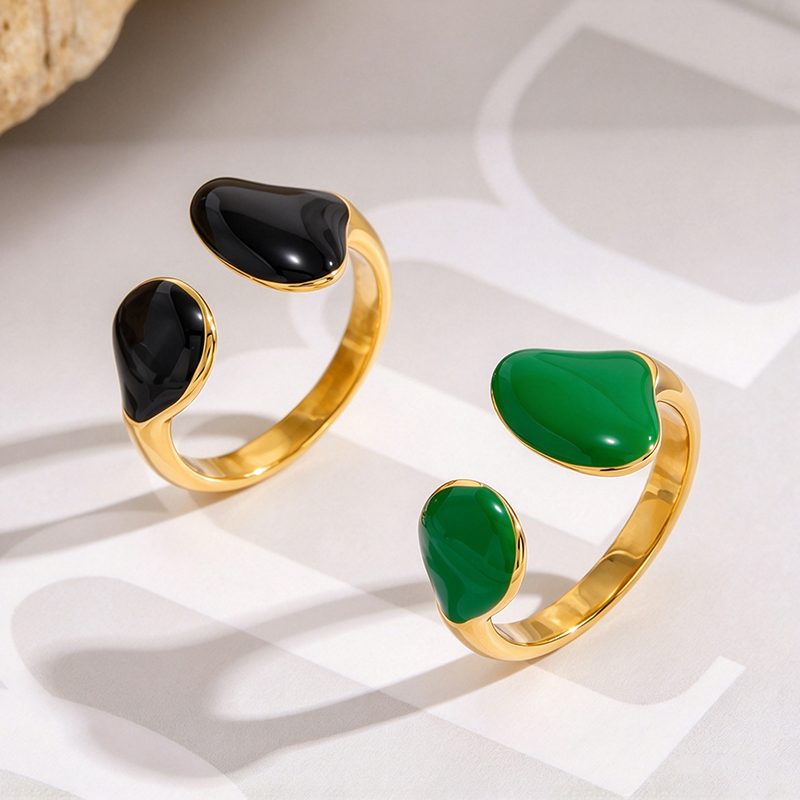
Here's where material choice quietly solves the problem. Precious-metal rings are sized forever — lose or gain a little weight and it's a jeweler visit. Steel rings can't be resized (the metal is too hard), which sounds like a disadvantage until you meet the industry's actual answer: open and adjustable designs. Most stainless steel rings for women — including the enamel open rings that dominate current collections — are made as adjustable open bands that comfortably span one to two full sizes, exactly covering the measurement wobble of at-home sizing.
That makes steel rings the low-stakes way to buy online or surprise-gift: get the measurement approximately right, and the design absorbs the rest. For gift sizing without the recipient knowing, Method 3 (borrow a ring they wear) plus the chart above is the standard play.
Wide Bands and Stacking: The Two Sizing Exceptions
Two popular styles break the standard rules, and both break them in the same direction — bigger:
- Wide bands (6 mm and up) cover more finger and grip more skin, so they run tighter than the same size in a 2 mm band. The working rule: go up a quarter to half size for every 3 mm of extra width. This is why a size 7 in a slim band and a size 7 in a wide statement band can fit like different rings.
- Stacked rings behave like one wide band once three or more sit together — the stack grips and doesn't slide as freely as each ring alone. Size the stack by the widest-wearer rule: if your stack totals 8 mm of width, a half size up from your single-ring size keeps the set wearable through a salty-skin afternoon.
Open adjustable designs, which dominate steel ring collections, absorb both exceptions — the open gap covers a quarter to a full size of give — which is one more reason they've become the default for online ring buying and gifting.
FAQ
How can I measure my ring size without a ring sizer? Wrap a 5 mm paper strip around the finger base, mark the overlap, and measure the length in millimeters — the chart above converts circumference to size. Measuring an existing ring's inside diameter works too, and is the best method for gifts.
What is the average ring size for a woman? US 6–7 (EU 52–54) covers most women, with US 7 the single most common. The finger the ring will live on matters more than averages — ring fingers run smaller than index fingers.
Should I size up or down if I'm between sizes? Size up, within reason. A slightly loose ring is wearable and adjustable open-band designs absorb the difference; a tight ring is uncomfortable from the first hour and swells worse through the day.
Do fingers change size during the day? Yes — fingers swell with heat, activity and salt intake, and shrink in cold. That's exactly why evening measurement is the rule: you want the size that fits your largest normal state, not your coldest morning.
Are stainless steel rings resizable? No — the metal's hardness makes conventional resizing impractical. That's why most steel ring designs are open adjustable bands spanning 1–2 sizes, which conveniently covers the uncertainty of home measurement.
How do I find her ring size without asking? Borrow a ring she already wears on the target finger type, measure its inside diameter in millimeters, and read the chart — Method 3 above. If no ring is accessible, a photo of her hand next to a coin can be compared against standard finger widths as a rough fallback, but a borrowed ring is far more reliable. Adjustable open-band designs exist precisely because this method carries uncertainty.
Is there a difference between ring size and band size? They are the same measurement — "band" simply describes the ring style. The word matters only as the wide-band caveat above: wide bands fit tighter at the same nominal size, so the style affects the size you should order, not how the size is defined.
 How to Start a Jewelry Brand in 2026: Step-by-Step
 Why Does Gold-Plated Jewelry Fade? (And What Lasts)
 How to Measure Ring Size at Home (3 Easy Methods)
 Necklace Chain Types Explained: Find Your Chain Style